Yasou,
Some on this email list asked me to share a chapter from the book. I’ve decided to share chapter 1, even though based on feedback I have received I may be changing chapter 1 to a whole different part of the story. I think this chapter or “scene”, where ever it eventually lands, is the heart of the book.
You will also notice that the name of the book has changed slightly. Based on feedback from a very experienced author, I have changed it to “Called to Greece: A Memoir of Love and Homecoming”.
For this version that I share here, I will add some annotations in brackets that will give you more context. And I would love your feedback. Does it give away too much. Would it hook you into reading the book? Or is it too mundane and you think there should be a more emotional introduction into my story?
Chapter 1 is written in third person, a cinematic introduction set in the village of Plomari located on the island of Lesvos. You will notice the name used is Katerina eventhough my actual name is Katina. That’s because that is the name people chose to call me in Greece. There was some negative connotation associated with the name Katina in Greece - so some insisted on calling me Katerina. And it stuck.
CHAPTER 1
Plomari,Lesvos – Summer 1997
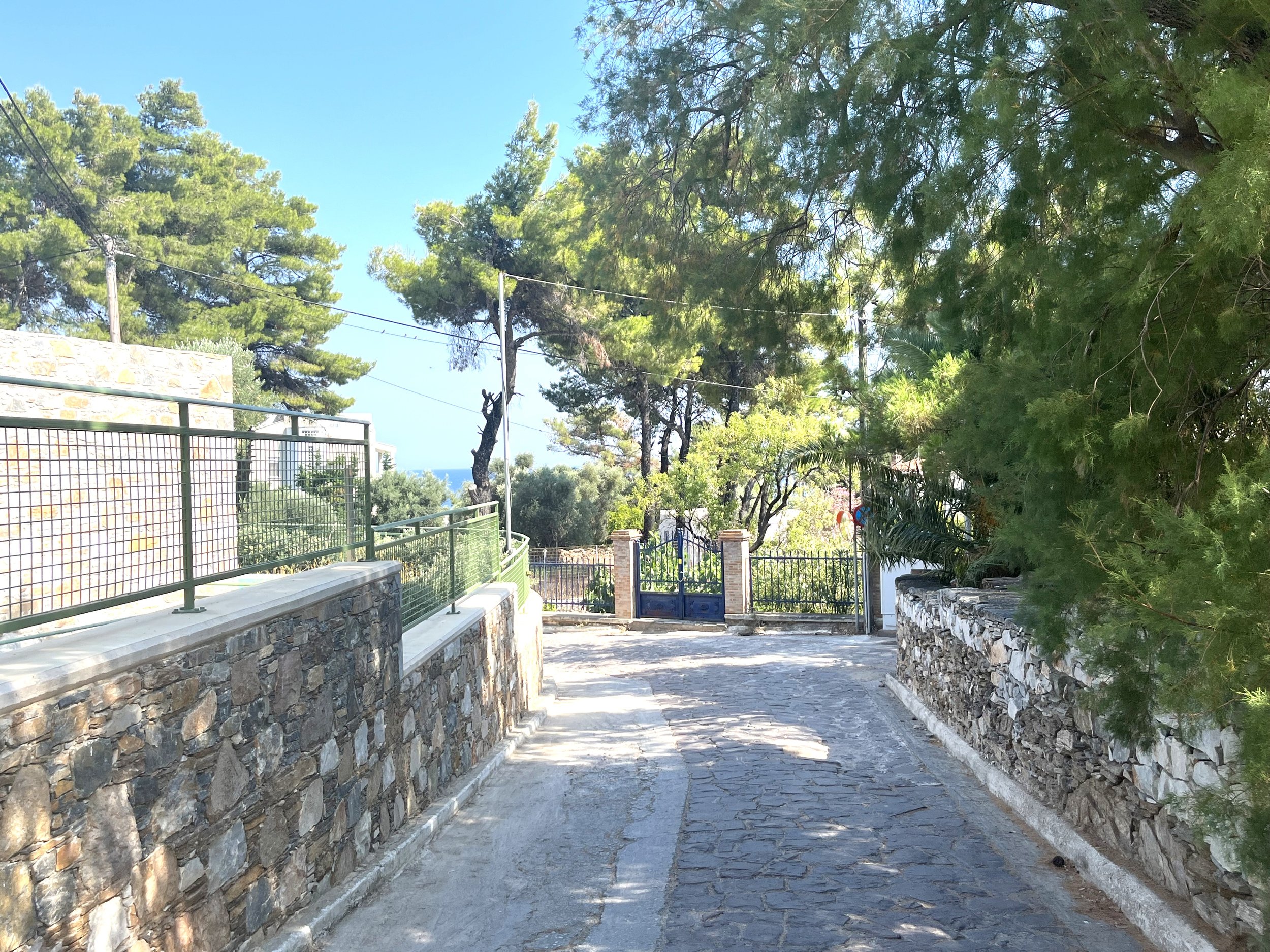
Katerina steps out of Hotel Sapho, its little balconies covered with flowers, and begins her evening run. Wearing spandex shorts and top - common American workout gear of the 90s. In front of her, the Aegean Sea, a church with terra cotta roof tiles, and a typical Greek pebble beach. It is the peak heat of the day at 6 P.M. as she starts down the winding road. The heat of the Mediterranean sun beating down on her olive skin. At the bottom of a hill, she stops and does her stretches across the street from Taverna Mouria shaded by a great sprawling tree. Turning down a narrow cobblestone street, she runs surrounded by rolling hills dotted with silvery green leaved olive trees and fig and orange trees. On either side of the street are houses with terraces, surrounded by little stone walls. Her mind and body settle into the serenity of it.
Katerina stops abruptly when a dog jumps out at her. Serenity shattered. From the house, a teenage girl [THIS WAS MY HUSBANDS LITTLE SISTER] shouts from the second-floor window “skase!”, and the dog settles down. She passes in peace waving to thank the young girl Mersina.
The cobble stone street winds down to the vibrant blue water of the Aegean, then appears to drop straight into the sea. Curving sharply at the last minute, it transforms into a narrow dirt road along the rocky shoreline - barely wide enough for a single car. At the edge of the sea, on a little peninsula, is a tiny white church with blue trim, no bigger than Katerina’s living room at home in the States. A sign above it reads Agia Varvara (St. Barbara). [THIS IS THE CHURCH WHERE WE CHRISTEN OUR FIRST BORN SON 3 YEARS LATER] Two Greek men emerge from the front arched doors of the church gripping the handles on either side of a large metal vessel of water. They walk down to the edge of the sea to dump the baptismal water from a recent christening. There is a small limani (port) with only a handful of docks – where small Greek wooden fishing boats are moored. An older man, Lefteri, with a head of thick salt and pepper hair [THIS WAS MY FATHER IN LAW] is returning from fishing with his catch for the day. He shouts across the water to her “melichronos” (honey color), referring to her sun-tanned skin. She giggles to herself.
Around the corner, at a taverna shaded by a great Mouria tree, a young man named Manuel sits under a palapa watching the street. When his mother Leonne comes out from the kitchen, he says to her in a South African accent, without taking his eyes off the street:
“Can you make me a frape?” The iced coffee Greeks drink all summer long.
She responds, “Why don’t you make your own?” in an even thicker South African accent.
“But I don’t want to miss her”.
His mother looks at him, then goes inside.
Leonne makes the frape for her son.
When she comes back out with the frape, Katerina is across the street, stretching in the afternoon light. Manuel watches her. Then he says, quietly, with complete certainty:
"There is my wife."
His mother sets down the frapé. "Aw, come on, man. You don't even know her."
He just smiles and picks up his coffee.
Katerina finishes her stretch and runs on toward the beach,. She has no idea anyone is watching.
She heads down a dried riverbed – dried by the summer heat – used as a road leading to the beach. She passes the Taverna Afrodite (the Goddess of love), a more modern Greek taverna on the beach [THE TAVERNA WHERE I WILL WORK BUSSING TABLES WHILE THERE]. Running, she anticipates jumping into the crystal clear blue water waiting ahead. From the Taverna Afrodite, an older Greek woman and her adult son wave to her as she passes yelling “kalispera” – good afternoon in Greek, and she waves and smiles responding “kalispera” back to them.
When she arrives on the sand, Katerina kicks off her running sneakers, wades in without slowing down, and dives. The water is clear enough to see her feet below her. She comes up and starts swimming a very technical freestyle stroke then flips on her back to look up at the sky, the hills and the white church she just passed. Taking a breath, she goes under again. From beneath, the sunbeams of light shoot through the water as if in another world entirely. After her swim, Katerina emerges from the water, grabs her sneakers and walks down the beach - drip drying as she heads back to her hotel. The young people on the beach watch her and whisper to each other as she passes.
“Zena.”
Yasou,
Katerina